For Digital Product Creators Who Refuse to Build (or Rebuild) Blind
How One Missing Step Guarantees Your Course Scales to the Real Income You Set Out to Build — Before You Ever Build It (Again)
Dear digital product creator,
Have you ever asked yourself what actually separates a creator scaling to 30+ sales a day… from one whose course never gets past a trickle — no matter how good the product is?
Whether you're about to build your course, or you already did and it stalled, the answer is the same. And it's probably not what you've been told.
It's NOT more traffic. You can pour a thousand buyers a day into an offer, and if it doesn't convert, more traffic just means more people saying no, faster.
It's NOT a lower price. Drop your price and watch what happens — sales barely move, or worse, they slow down. Something else is stopping the yes, and it's not the number on the page.
It's NOT more bonuses. Stack ten bonuses onto an offer that isn't converting, and you'll find out the hard way: bonuses don't fix whatever the real problem is. They just delay you from finding it.
It's NOT a better sales page. Hire the best copywriter money can buy, split-test ten headlines, obsess over every word — and if you're honest with yourself, you already know: the words were never going to be the thing standing in the way.
It's NOT the wrong niche. You can be in the hottest, most profitable niche on the market — and your course can still end up collecting digital dust. Being in the right niche matters, sure. But it was never a guarantee that your product would scale.
So what does make the difference?
I didn't figure it out in a boardroom, or from some guru's course.
I found it the hard way — after watching five of my own courses fail, one after another, for reasons I couldn't explain at the time.
By the fifth flop, I stopped asking "how do I market this better" and started asking a different question entirely. That question changed everything — and it's the same question I'm about to hand you.
But first, let me take you back to where it started, because you need to see exactly what went wrong before the answer will make any sense.
Back in 2022, I created my first digital product.
It was a massive success.
I followed the exact path most gurus preach:
- Step 1: Market research.
- Step 2: Pre-sold it with Meta ads before it even existed.
- Step 3: Got 5+ founding buyers to prove demand.
- Step 4: Built the course.
- Step 5: Launched it. Scaled it.
That approach works. I want to be clear about that. But it's missing one step — and I wouldn't find out what that step was until it cost me five products in a row.
Later that year, I did it again. Second product, same path.
Also a massive success.
Two for two. My ego inflated fast. I started thinking of myself as someone who just... knew how to build things that sell. I'd cracked the code.
Then I built my third course.
Same research. Same pre-sell. 5+ founding buyers, right on schedule, proof of demand sitting right there in my inbox.
I built it. I launched it.
And it made a few sales here and there — just never enough to add up to anything close to a decent income.
I told myself it was the ads. Spent weeks tweaking them. Sales barely moved.
Told myself it was the price. Dropped it. A trickle of sales, nothing more.
Told myself it was the sales page. Rewrote it — twice — convinced the words weren't landing.
They landed fine. That wasn't it either.
Eventually I did what most creators do at that point: I gave up on it. Let it sit there, collecting digital dust, and told myself it was just a fluke.
So I picked a new niche. Fresh start, hot market, clean slate.
Fourth product. Flopped again.
Same story. Same slow bleed of "maybe it's the ads, maybe it's the price, maybe it's the page." Same ending — another course stuck making pocket change instead of the income I was actually building toward.
I won't walk you through the fifth. Or the sixth. By then the pattern wasn't a mystery, it was just painful — I kept carrying the same unanswered question into every new attempt, which meant I kept getting the same answer.
Five flops. Two successes. And no idea what separated them.
By the fifth flop, I stopped asking "what's wrong with this ad" or "what's wrong with this price," and asked a different question for the first time:
What did the two that worked actually have that the five that failed didn't?
I went back and looked. Really looked.
And here's what I found:
Every single person selling — myself included — is doing the exact same job. We're all taking a prospect from where they are now (Point A) to where they want to be (Point B). That promise never changes. It can't. It's the thing the prospect already wants, and none of us get to redefine that.
But how you get them from A to B? That's not fixed. That's the one thing you actually control.
And on five of my products, my "how" looked, sounded, and felt exactly like everyone else's "how." Same structure. Same angle. Same promise, delivered the same way as the twenty other options already sitting in my prospect's browser history — options they'd probably already tried, and probably already been let down by.
I hadn't just failed to stand out. I'd unknowingly built my own competition.
And it's only gotten worse since. The days when you could be the only solution in your niche — the only pub in town — are long gone. AI put course creation on easy mode. Throw together some slides, record a few videos in an afternoon, and you've got a "course." Everyone and their grandmother can do it now. Which means the shelf you're placing your product on is more crowded than it's ever been.
On my two successes, without fully realizing it at the time, I'd done something different — I'd gotten my prospect from A to B in a unique way, one they hadn't seen before. That's the only variable that changed. Not the offer. Not the niche. Not the ad spend.
The "how."
I call it Breakthrough Positioning — and it was the missing step in every single one of my five flops.
Here's what it does when you get it right: your prospect is left with exactly three options:
- Give up on finding a real solution.
- Settle for one of the inferior options they've probably already been burned by.
- Or take the only option that's actually new, actually different, actually exciting, and actually built to get them where the others couldn't —Yours.
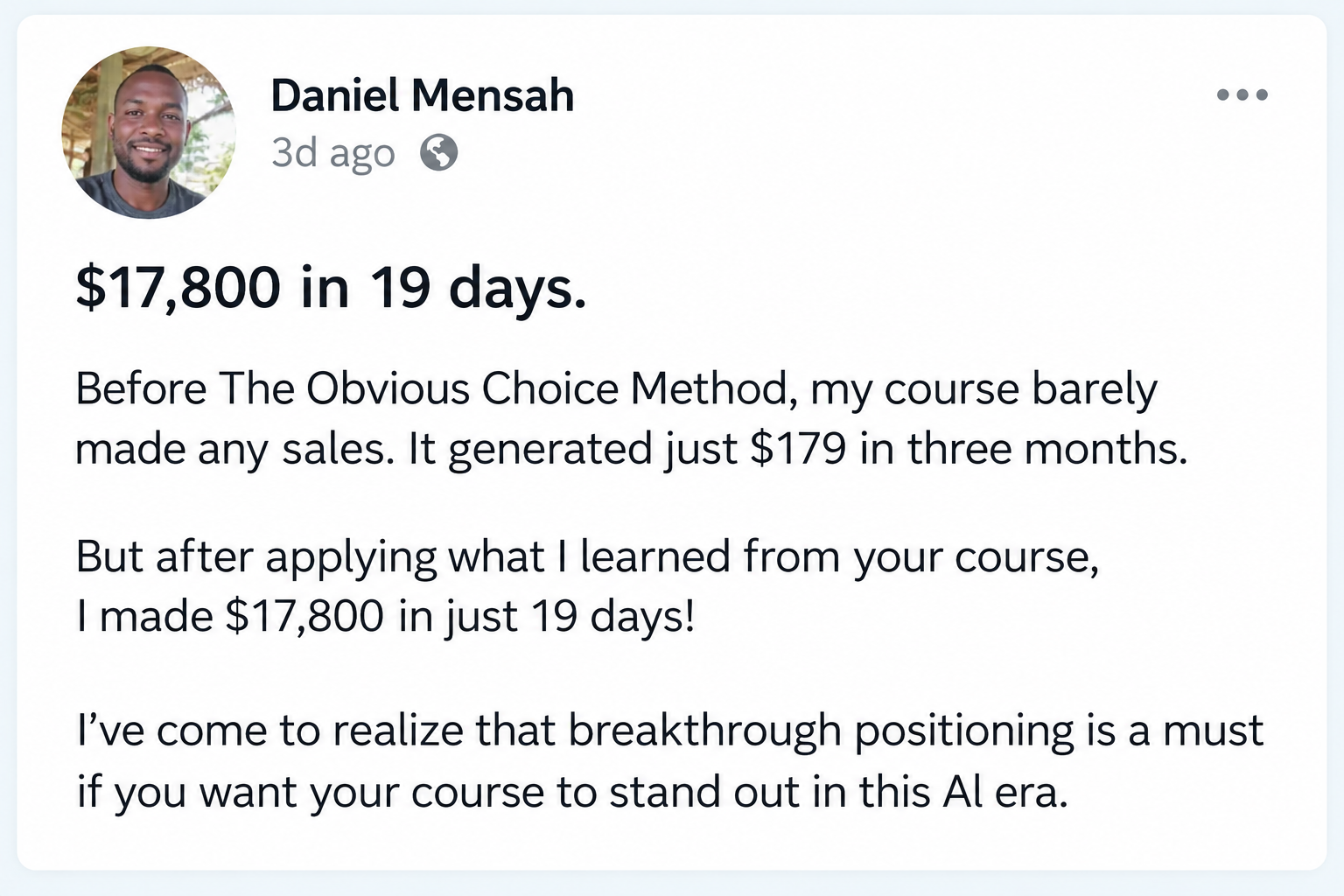
Here's something most creators never stop to consider: almost nobody buying in your niche is a blank slate.
They've either already tried a solution and got let down by it — or they're about to try a few before they land anywhere. Comparison shoppers, every one of them. Whether they've been burned once already or they're mid-search right now, scrolling between five tabs that all promise the same thing.
Which means the game was never about outselling the competition. It's not even about winning a brand-new customer.
It's about STEALING a dissatisfied one — someone who already paid for a solution like yours before. They hoped it would finally work. It didn't.
Maybe it was the product's fault. Maybe it wasn't — maybe they gave up too soon, or used it wrong, or life just got in the way. Doesn't matter. Fair or not, it left a bad taste in their mouth.
So they're not looking for another option that looks just like the one that let them down. They're looking for one real reason to say yes again.
Give them that reason, and you're not competing for attention in a crowded market. You're the only name left standing when they've ruled everything else out.
You become the obvious choice.
That's what I built The Obvious Choice Method to do.
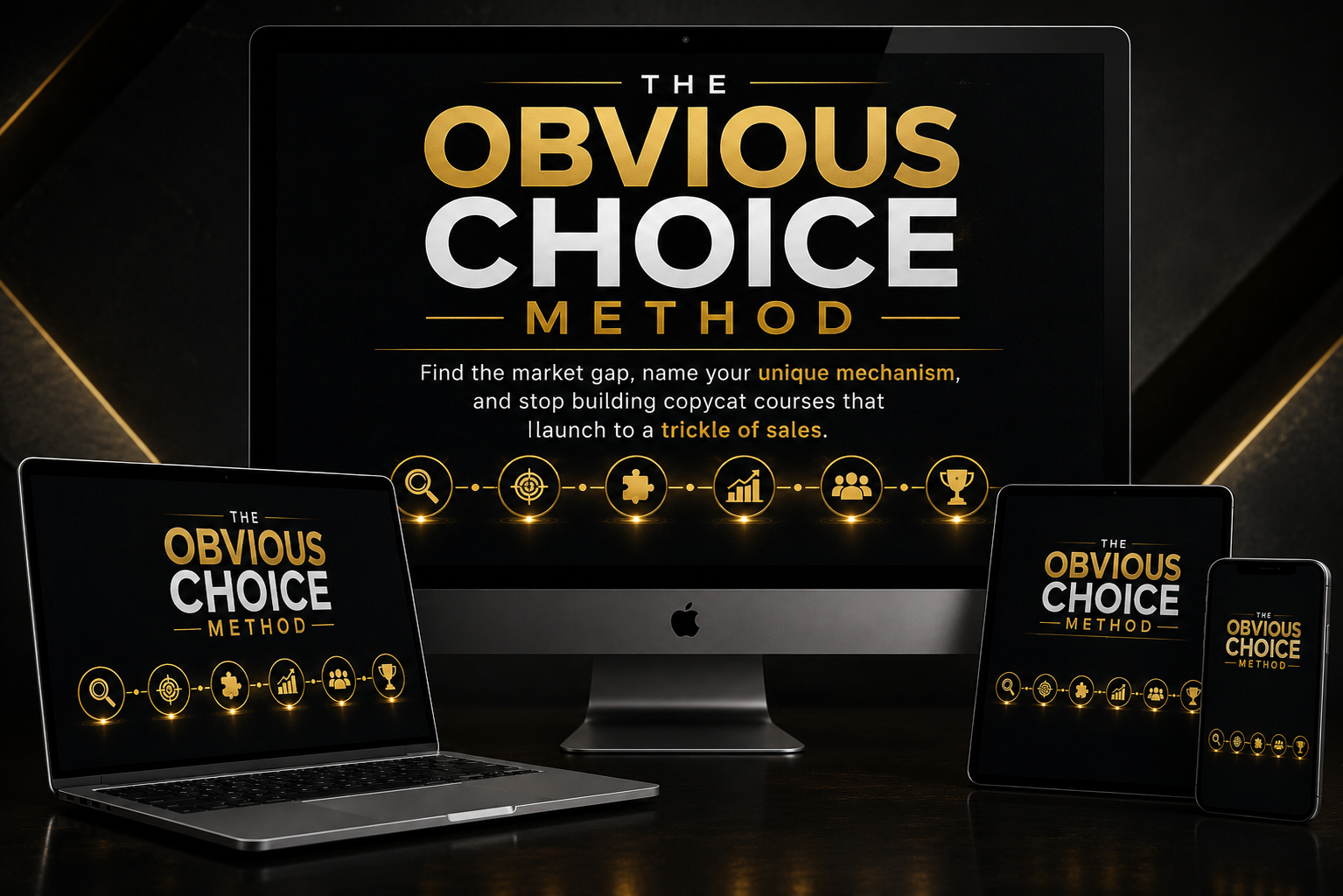
The moment your product becomes the obvious choice, marketing stops carrying the entire weight of the sale. Your ads don't have to do all the convincing. Your sales page doesn't have to overcome every objection alone. Your product starts doing part of the selling before a single word of copy ever has to.
Here's a brutal truth: Marketing can't manufacture positioning. It can only tell the truth about it — which means if the product isn't actually different, no amount of marketing will make it feel that way for long.
Let me be clear about what The Obvious Choice Method is not.
This is not a course on how to create a digital product. This is not a course on funnels, ad spend, or copywriting. This is not another "niche down and find your passion" pep talk.
If you're about to build your course, you don't need another voice telling you how to build it. If you already built one and it flopped, you don't need another voice telling you to market it harder.
What you need is the piece nobody's teaching: how to make sure the thing you build — or rebuild — isn't just another option in a crowded shelf of lookalikes.
The Obvious Choice Method is exactly that. It's the missing step that turns "I have no idea what makes me different" into "I have the obvious choice product" — before you spend a single dollar on ads, before you rewrite a single sales page, before you repeat the same mistake I made five times.
Here's the 6-step path, the one every guru teaches — with the piece that's always been missing, finally in its place:
Step 1: Market research.
Step 2: Find your Breakthrough Positioning (the missing piece)
Step 3: Pre-sell it with meta ads before it exists
Step 4: Get 5+ founding buyers — proof of demand for the obvious choice.
Step 5: Build it.
Step 6: Launch it. Scale it.
Notice where positioning sits. Not after you've built it, hoping it lands. Not somewhere in your marketing, hoping better copy fixes it. Right at the start.
If you haven't built yet — This is your insurance policy. It stops you from spending the next three months tweaking the marketing of a product that is doomed to look exactly like everyone else's.
If you already built, launched, and it flopped — this means going back to step 2 before you touch your course again. Not a facelift. Not a re-launch with better ads. A real return to positioning, because whatever got built the first time got built without it.
Either way, the rule doesn't change: if step 2 is wrong — or missing — no amount of steps 3 through 6 will save you. I know. I proved it five times.
And here's what that one change actually does for you: when you get your 5+ founding buyers in step 4, you're no longer just proving people want a solution. You're proving they want your solution — the differentiated one, the obvious choice — before you've built (or rebuilt) a single lesson. That's not the same validation everyone else is chasing. That's validation most creators never even know to look for.
And that's how you generate 30+ sales a day once you scale it. Because you're NOT pouring traffic into an offer that looks like everyone else's, hoping this time it converts. You're pouring traffic into something your prospect already recognizes as the obvious choice — which means every dollar you spend scaling works harder, instead of getting lost in the noise of a hundred lookalike options.
So how do you actually find your Breakthrough Positioning?
Not by guessing. Not by "finding your voice" or "niching down" or any of the vague advice that sounds good on a podcast and falls apart the moment you sit down to actually do it.
I built a process for it. I call it the Milestone Mapping Method — eight steps that take you from "I have no idea what makes me different" to a positioned, differentiated offer you can point to and defend, line by line.
And no, this isn't a new curriculum you'll add to the pile and never open. It's a focused, sequential process — not a semester-long deep-dive. You can move through all 8 steps in a day, not weeks.
Here's exactly what the Milestone Mapping Method does for you:
Step 1-2
It maps your prospect's entire journey from where they are now to where they want to be — independently of what any competitor teaches — so you know the real path before you ever compare yourself to anyone else.
Step 3
It shows you exactly where your own expertise fits on that path, so what you build is credible, not a shallow attempt to cover everything.
Step 4
It shows you what everyone else in your space is actually offering — not their sales page promises, but what they really deliver — and why it's the exact "solution" your prospect has probably already tried and been let down by.
Step 5-6
It shows you the milestone on your prospect's journey that everyone else skips, rushes, or gets wrong — and validates it's a gap buyers actually get stuck on, not one nobody needs.
Step 7
It shows you whether that gap is one product or a product ladder — so you walk away not just with an insight, but with a clear structure for what to actually build.
Step 8
Finally, it shows you how to close that gap with a mechanism that's unmistakably yours — the "best solution" your prospect has been comparison-shopping for all along.
None of this is about understanding your market better for its own sake. It's about never again spending three months building something nobody was waiting for. It's about never again watching a launch go quiet while you wonder what you missed. It's about finally building the thing you meant to build the first time.
By the end, you're not left with more theory. You're left with a validated, positioned course idea — and a clear decision on exactly what to build first.
That's the difference between a course that looks like everyone else's, and one that becomes the obvious choice the moment your prospect sees it.
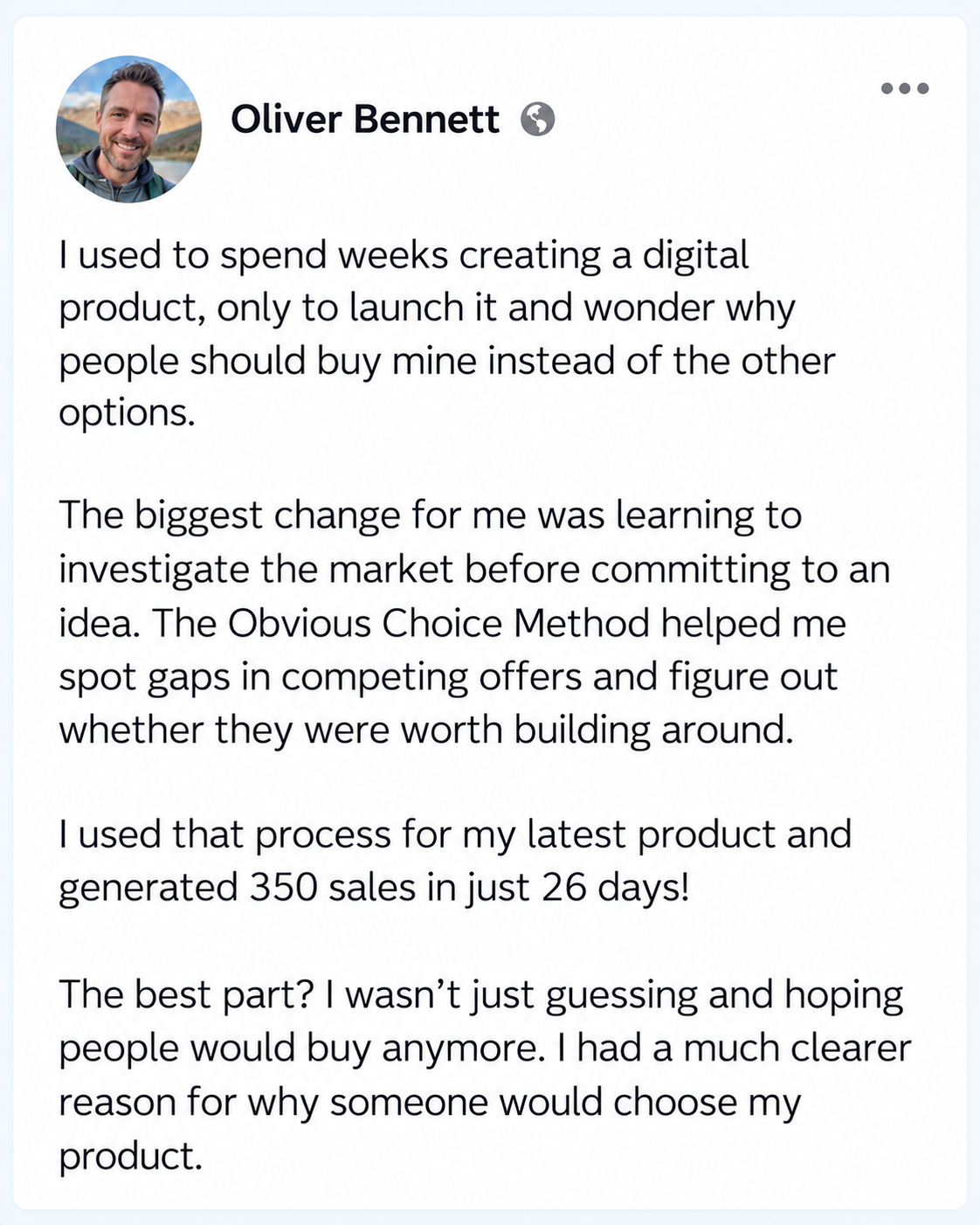
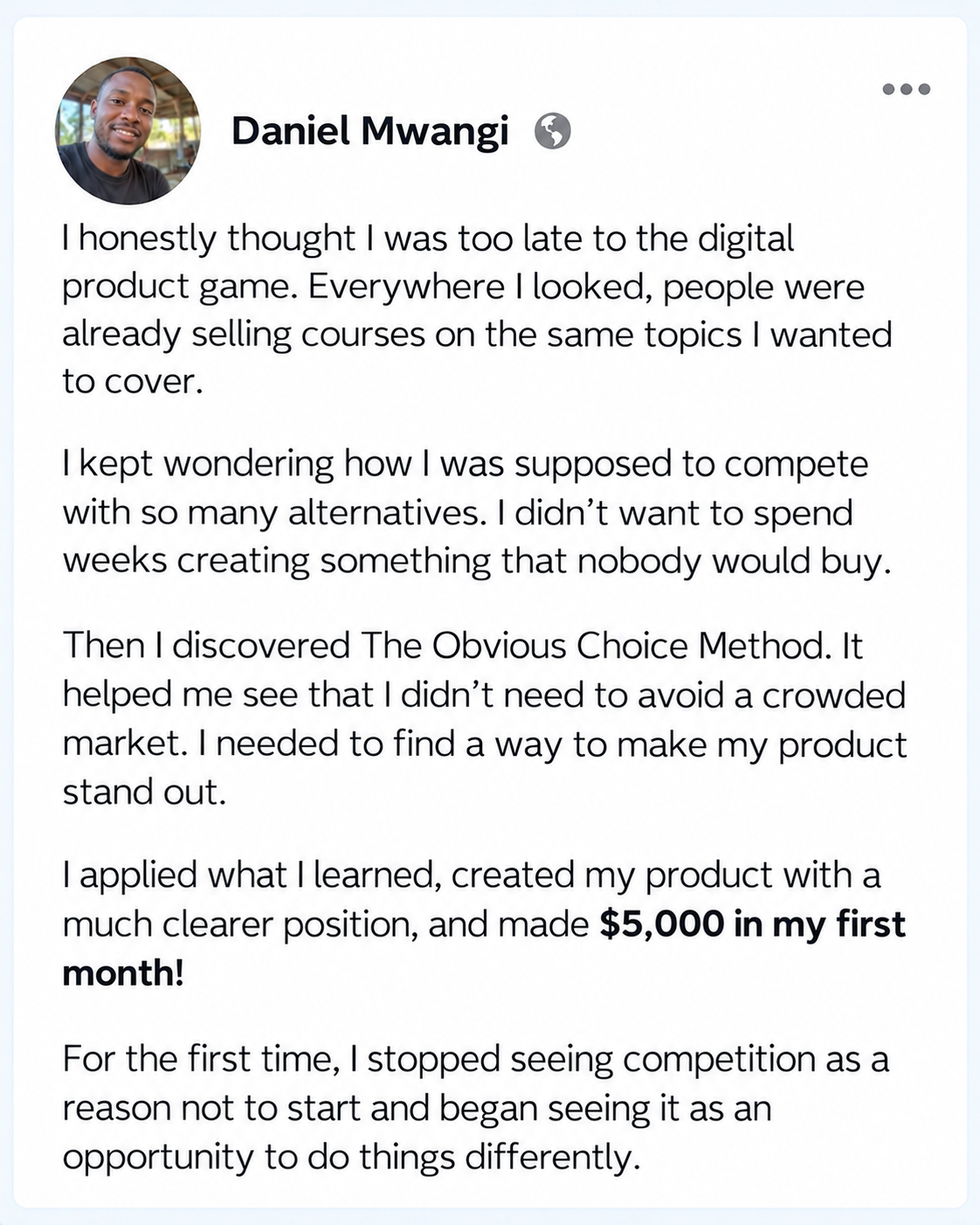
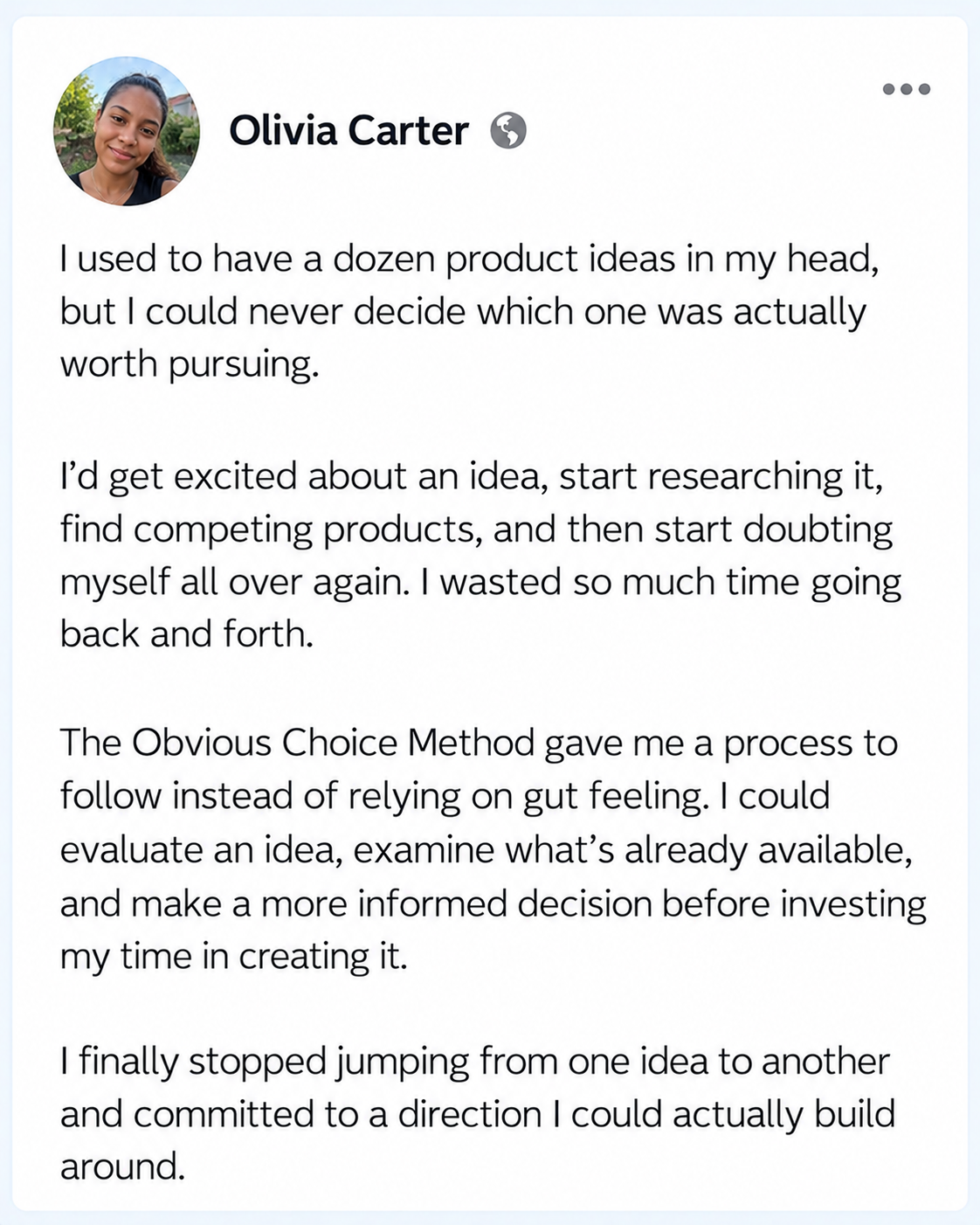
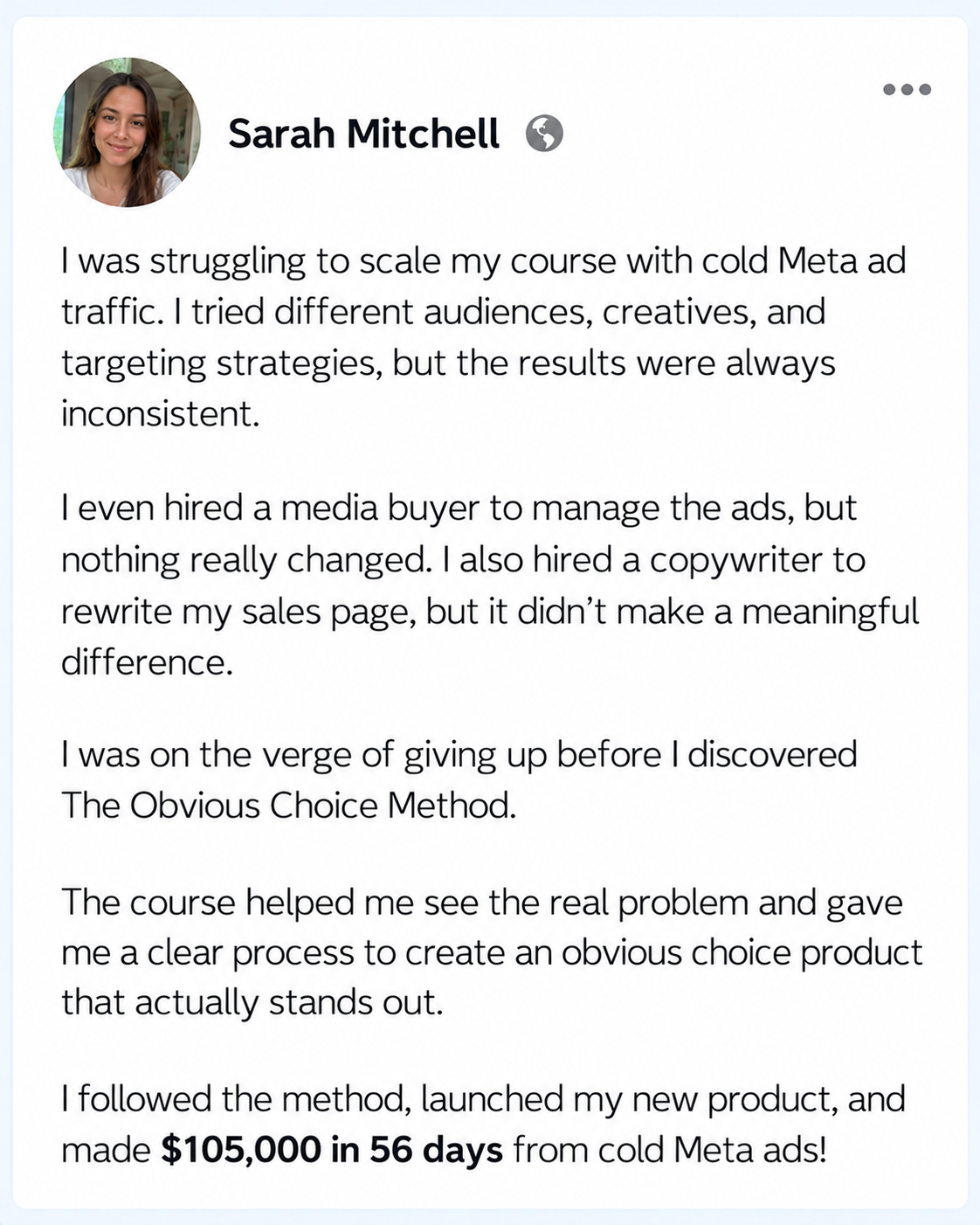
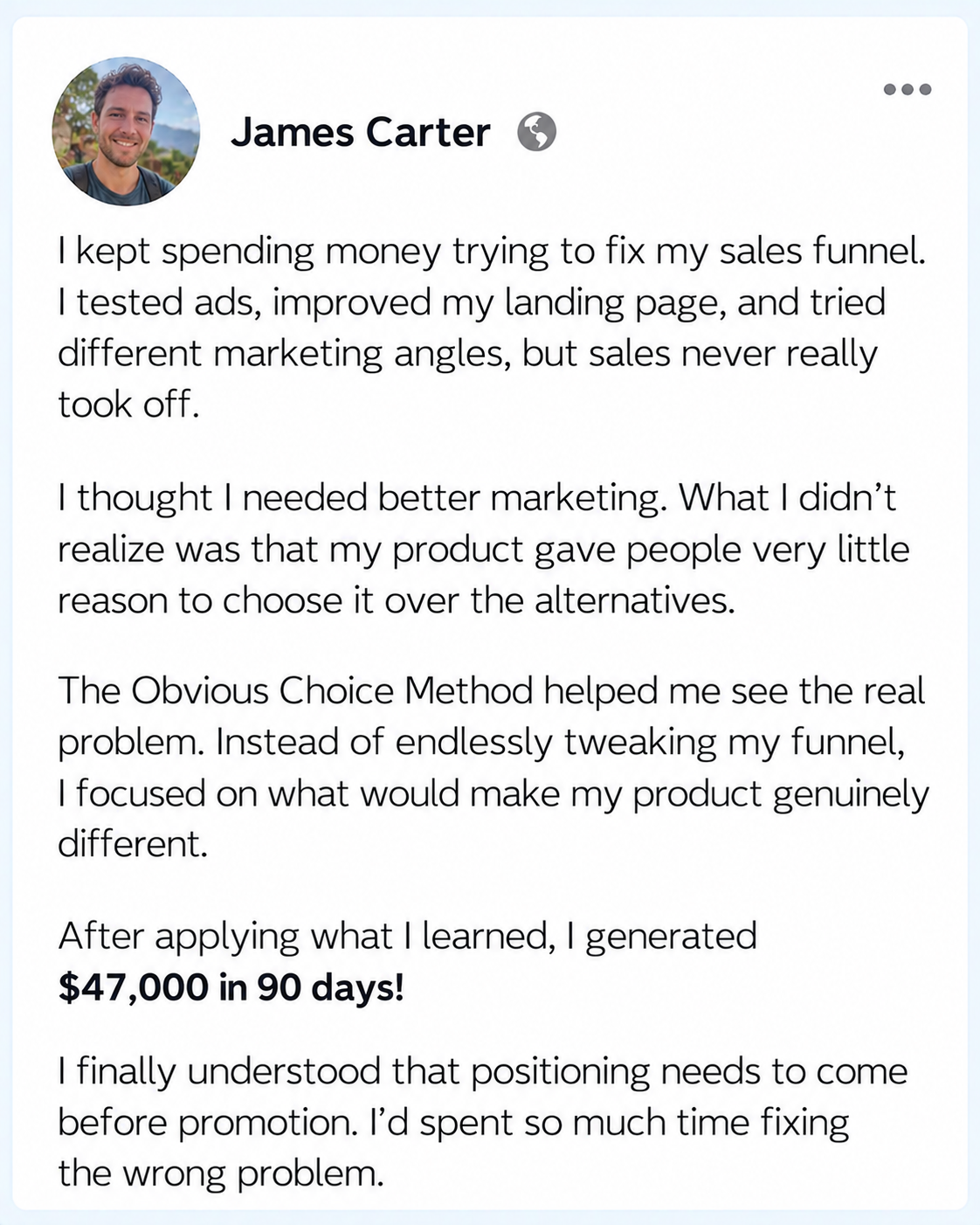
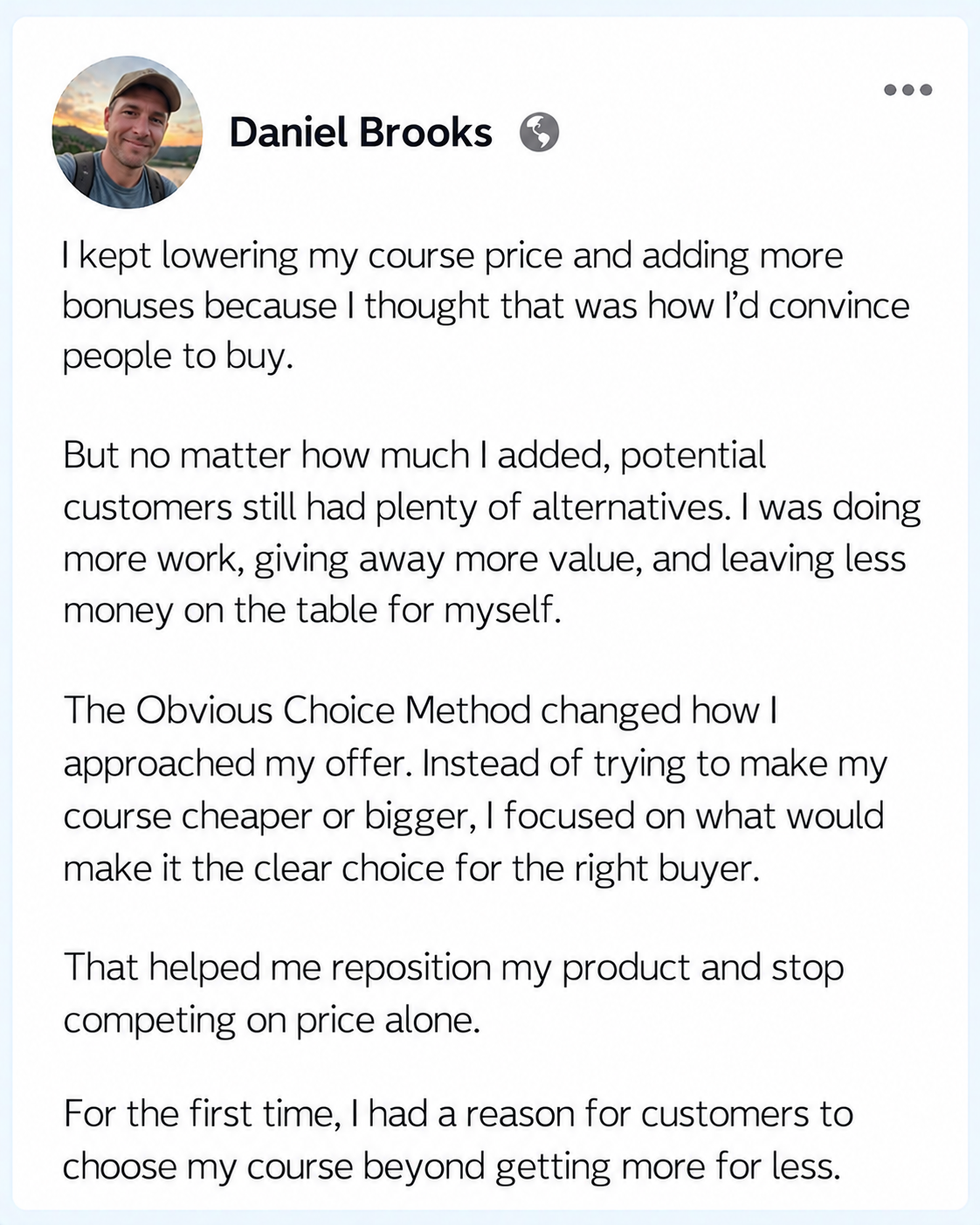
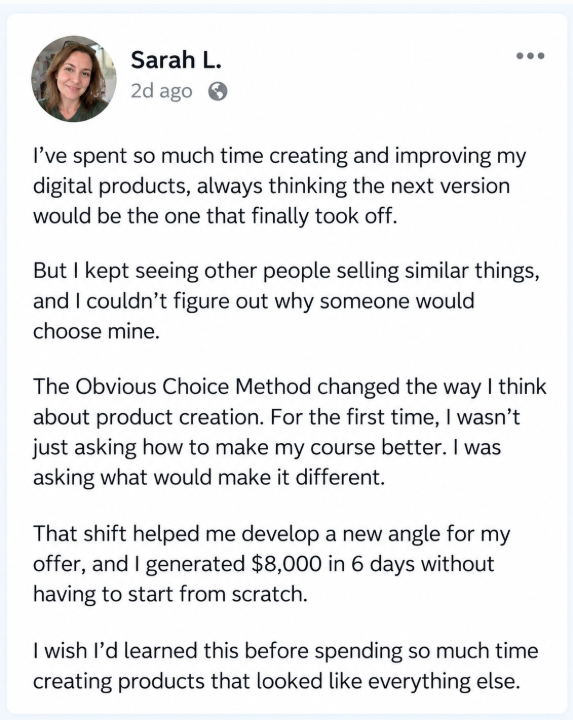
What Happens When You Learn to Make Your Product the Obvious Choice
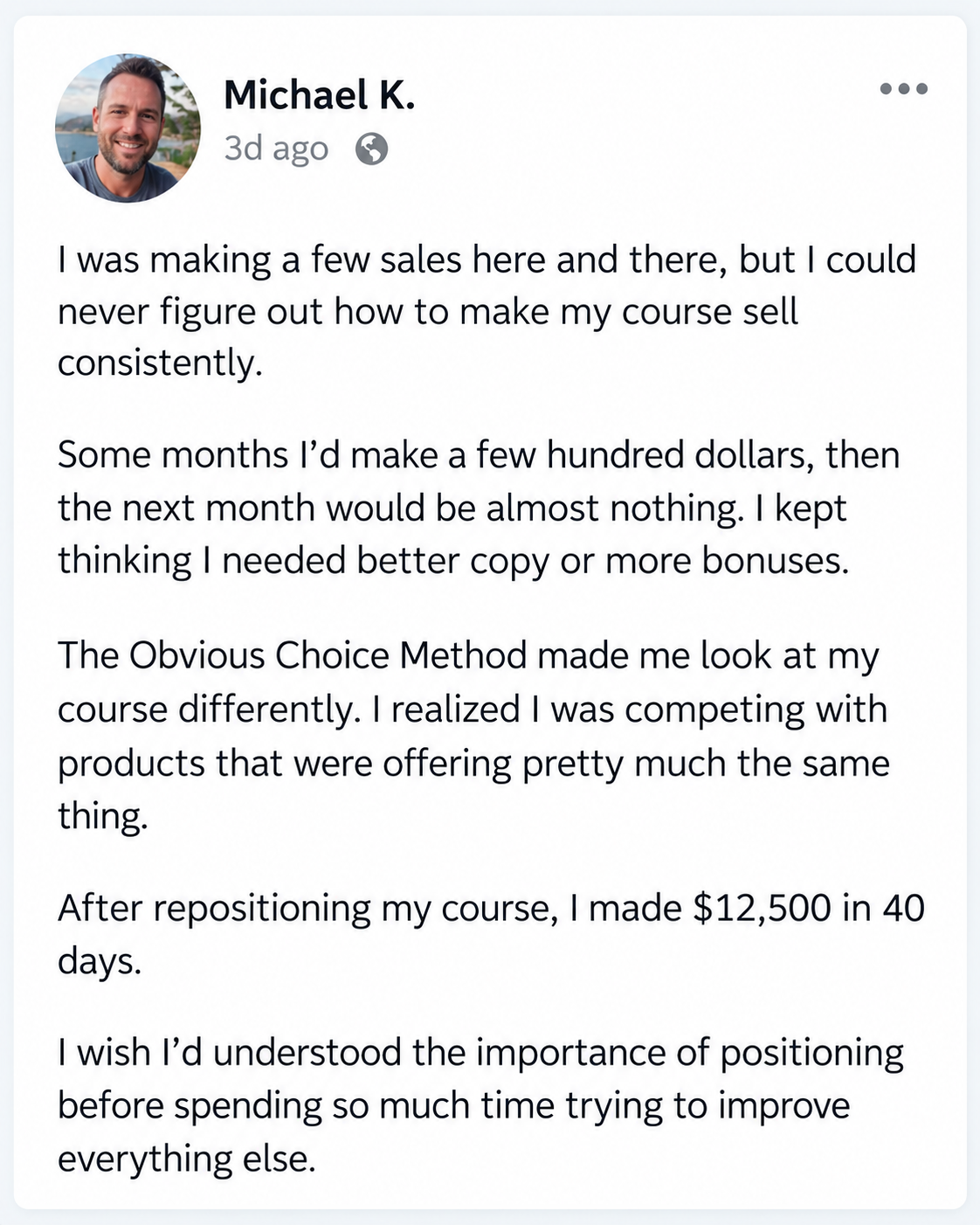
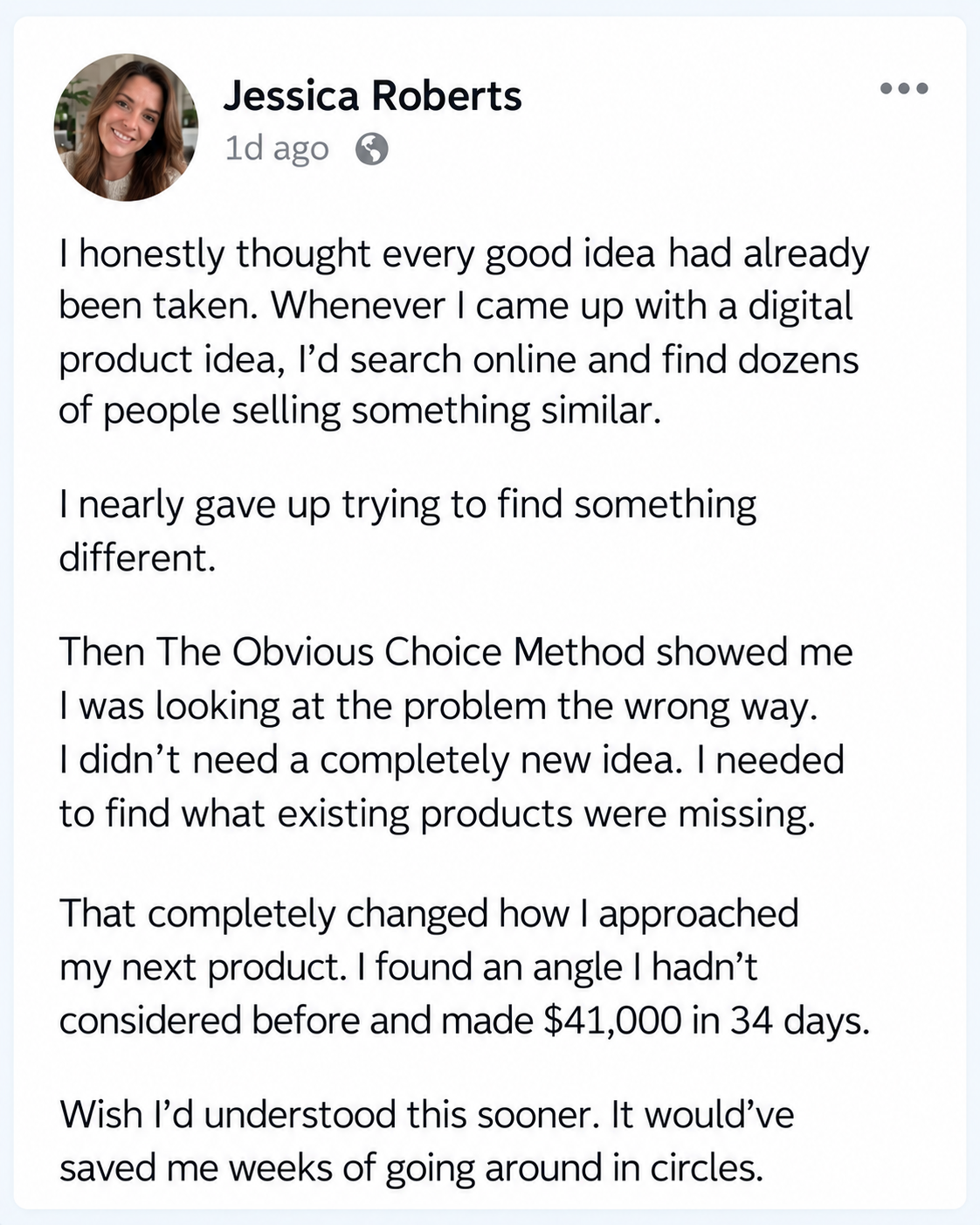

Backed by My 30-Day Positioning Guarantee — You Find Your Obvious Choice, or You Pay Nothing
If you've read this far and haven't joined yet, I'm guessing you're interested… but still wondering if this is really going to work for you.
Totally fair. You've probably been burned before — by a course, a guru, a "system" that promised a lot and delivered repackaged videos.
So let's remove every ounce of risk and flip the table — you try it, and I'll take the risk.
Here's how it works:
Get The Obvious Choice Method. Go through the training. Walk through the Milestone Mapping process on your own offer, step by step, exactly as laid out — all 8 steps, start to finish.
And then — one of two things will happen:
Option 1: It works.
You map your prospect's journey, find the milestone everyone else in your space is skipping, and walk away with a positioned, differentiated product — the one your prospects can't say no to, because it's not competing with the same five lookalikes anymore. It's the obvious choice. You'll realize this is the piece that was missing the entire time.
Option 2: It doesn't.
If you went through the full training, ran your own offer through all 8 steps of the Milestone Mapping process, and did it within the next 30 days — and you still don't walk away with a positioned, differentiated offer you can point to and defend — let me know, and I'll refund 100% of your money.
This means you have absolutely NOTHING to risk
And everything to gain.
The way I see it, you have three choices now.
Choice #1: You can forget about everything I've told you today… go back to doing what you've always done… and get what you've always gotten.
But if you were confident your next launch would actually take off — or if your current one was already performing the way you hoped — you wouldn't still be reading this page.
And you are still reading. That tells me you're ready for something to change.
So doing nothing makes no sense at all. You've got to take action.
Choice #2: You could forget about me and go looking for another course.
Good luck with that.
Because the Milestone Mapping process I'm showing you is unique. I've never seen it taught publicly anywhere else.
Now, could you figure out positioning on your own, without a system? Technically, yes. But I tried that — five times — before I built this. Every creator I know who's actually scaled past their first few sales did it with something that differentiated them. None of them just got lucky twice in a row.
So your odds of stumbling onto it alone, the way I nearly didn't? Slim.
Choice #3: Grab The Obvious Choice Method today and get a system for finding the one thing traffic, price cuts, and rewritten sales pages will never hand you on their own: an offer your prospects actually see as the obvious choice — whether you're building it for the first time, or making sure the next version actually works.
The people who get this today and actually run their offer through the process will finally stop guessing whether it's going to work — before they ever hit launch, or the next time they do.
The only question now is: will you be one of them?
Or will you be here again next month, staring at another quiet launch, wondering what you missed?
If you're ready to stop being one of the lookalikes, click "YES, I WANT THE OBVIOUS CHOICE METHOD FOR $97 $37" below.